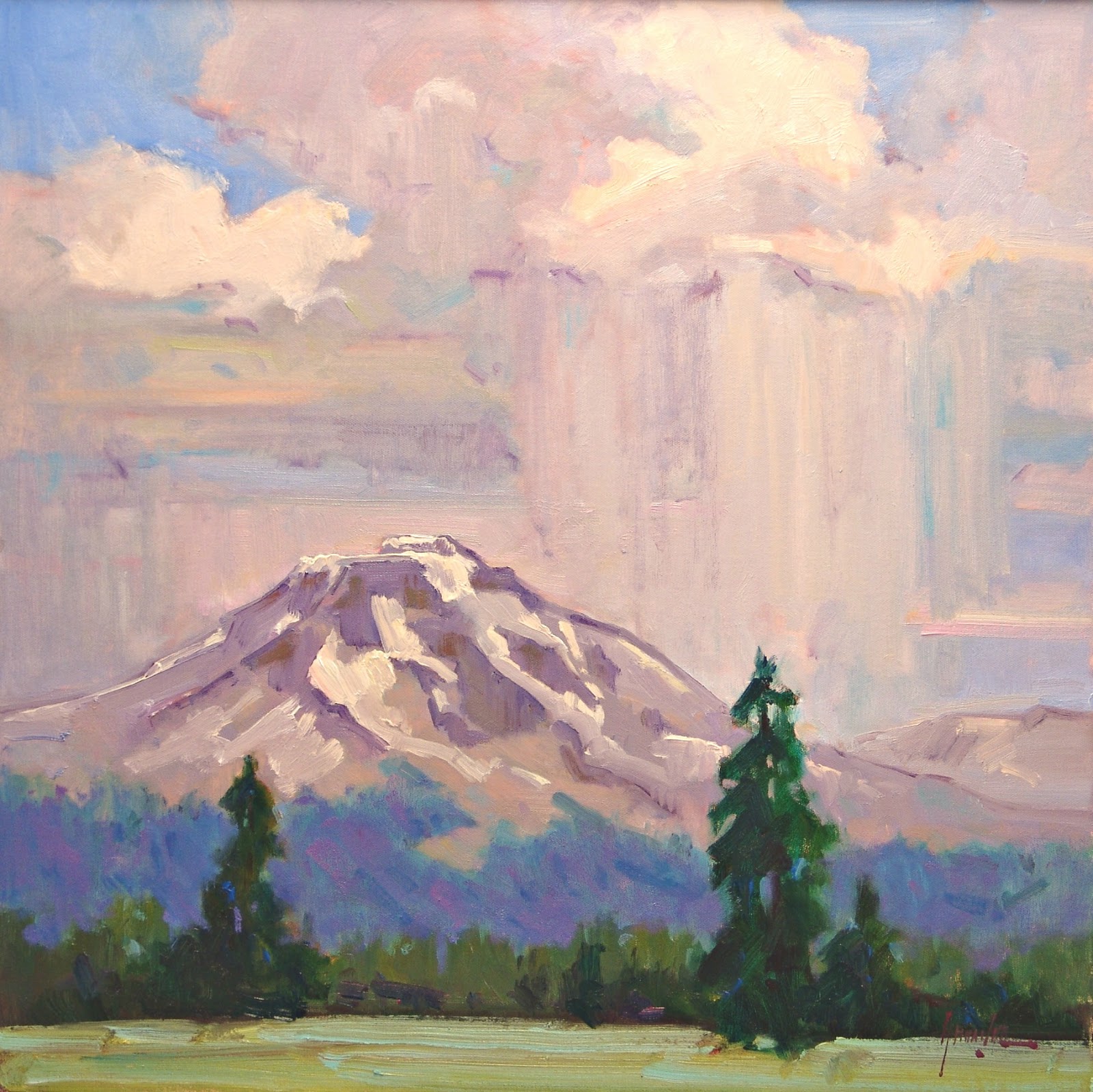
Tuesday, June 30, 2009
More New Work in September!
Meanwhile, enjoy reading through the postings here. Comments are always welcome. Also, what would you like to see or have me discuss?
---SFG
Friday, March 13, 2009
"Mendocino Morning Glow"

NOTE TO ARTISTS:
For the last year or more, I've concentrated on more dramatic atmospheric effects. Since I'm mostly a fair weather plein air painter now, I've had to draw on those years of experience and knowledge of what light and color do. I've found that I pay more attention to composition when I'm 'painting out of my head'. Such an approach was advocated by my best teachers, as long as it was only one of the methods used and direct observation was practiced most often. --- SFG
Wednesday, March 11, 2009
"Clear Day"

"A little artist's license... rearrangement of buildings and trees... made this scene sparkle. I used the reflections in the water to direct me and the pristine day added its flair." --- SFG
NOTE TO ARTISTS:
As they say, it's more about what you leave out of a painting than what you put in. It's also about where you put it. Rarely is a subject perfectly composed and the artist who is sensitive enough will either eliminate an element that is not working or move it. I used the direction of light on the fronts of these two buildings - one outside the picture plane - to create a reason for the reflections in the water.
Thursday, March 05, 2009
"Half Dome, Yosemite"

"This famous landmark in Yosemite National Park is familiar to legions who love the out-of-doors. No, I did not stand with my feet freezing in the snow this time, but I've turned a photo record into a credible artwork. Photos are not truthful - colors are inaccurate and shapes are distorted by the camera lens - , so I had to incorporate the storehouse of knowledge I've accumulated in my 35 years of painting." --- SFG
NOTE TO ARTISTS:
Nothing can replace painting on location to hone one's skills and provide all of the information needed to produce a skillful work. However, almost all fine artists will add refinements to small works or use the plein air sketch to produce larger works in the studio. Surprisingly, for a large work, you need more detail...meaning information..., not less.
Wednesday, March 04, 2009
"Cool Day at Clear Creek"

"The Redding, California, area is becoming home to many delightful trails for walking, mountain biking, etc. A new one follows Clear Creek through areas that previously were not easily accessable. This rugged canyon is cut sharply through granite and roars in the springtime. In autumn, when this painting was done, it is still very dramatic and offers gravel beds for spawning salmon." --- SFG
NOTE TO ARTISTS:
This complicated rock formation had to be broken down into two basic values of light and shadow. Since the sun was so strong coming from the left and the far bank was in deep shadow, it was easy to do so. I had to be careful from then on to keep everything in shadow simplified and within a very close value range. I constructed the painting so that the diagonals countered one another and led the eye to the sunlit boulders and the soft needles of the two small trees. The bright coloration of the foliage at the point of the sunlit bank was the strongest contrast in color and value.
Thursday, February 26, 2009
"Laundry Day"

"I shared models with other artists on a trip to Ruidoso, New Mexico. This coy model kept a lively expression and was a delight to paint as she and her compatriot pretended to sort and hang laundry. It made for a colorful subject and pleasant work for all of us." --- SFG
NOTE FOR ARTISTS: To compose this work, I used the natural bands of light, dark, and light again. The shadow of the trees, formed the natural dark which set off the sunlit hat and apron of the main figure. Note the location of that figure. She is off center, a bit to the right. The chair on the right helps anchor that edge and balances the larger light and smaller figure on the left. Sunlight is represented by the value contrast and reinforced by warm and cool colors.
Friday, February 06, 2009
"McCloud, First Snow on Shasta"

"McCloud, First Snow on Shasta" - Oil - 8" x 10" - $300
"An unexpected snow storm covered Mt. Shasta in early November and gave a preview of the upcoming glory that visits its slopes yearly. The view is especially breathtaking from the charming town of McCloud. Its just a few minutes off Interstate 5 and well worth a detour." --- SFG
Thursday, January 01, 2009
"November in McCloud"

"A cool autumn day rendered this view of an alley in the charming town of McCloud, California. The glowing light set off this delicate color harmony that enhanced the fall colors. There are countless subjects for painters along the alley way such as old garages, tool sheds, wood sheds or wood piles, varied fencing, trash cans, and a delightful jumble of varied shapes and objects." --- SFG
"Mill and Mountain"

"The early 20th century lumber town of McCloud in northern California sits below Mt. Shasta. The picturesque scene here is of the old mill on the east side of town and was bathed in early autumn light. This is another of a series of paintings done in the area in November 2008." --- SFG
Wednesday, December 31, 2008
"McCloud Power Source"

"On this corner in McCloud, California, sit two churches dating back in this old lumber town. The Catholic church, built of logs, faces the viewer and the Presbyterian church is the white building to the right of it. I couldn't help noting the prominent power lines, the other power source for this charming town." --- SFG
"Conversation in the Alley"

"McCloud is a small lumber town near Mt. Shasta in beautiful northern California. People often forget this part of California, but that's the way people in McCloud like it. Since the mill has closed, McCloud has become a hideaway for city dwellers who enjoy small town history and friendliness. Since the garages are often located on the alleys, friends meet and catch up there." --- SFG
"Beside the Sacramento"

"On this overcast day, the color across the Sacramento River was blended into a harmony of lavenders and autumn oranges. The near side had it's usual mix of grasses, shrubs, and trees and a lively dance of intertwining branches, all whipped by the wind that unsteadied my easel." --- SFG
"Autumn at the Creek"

"I love to paint water. The chance to paint reflections, transparent water and what's below the surface, and whites in waterfalls and turbulence is always a challenge and such fun. This stream had a small waterfall in the foreground and I painted it quickly with broad strokes. The trees and shrubs surrounding it gave definition to the scene"." --- SFG
"Appy in Waiting"

"This Appaloosa was in the upcoming halter class and the handler had her ready and waiting near the horse show photographer's background drape. While sunlight warmed her back, the shadow side of her became a lovely aqua." --- SFG
NOTE FOR ARTISTS:
I used the strong contrast of color and value to compose this small piece and it became a bigger statement. It would have been static and boring if I had not given the human figure an unexpected pose. The darks of her pants and the head of the darker horse on the left balanced the scene. Watch for such opportunities while you are painting and put them in quickly with assurance. If you don't get it right the first time, wipe it out and lay it in again. Temerity always shows.
"What a Life"

"'What a life,' is a phrase I utter frequently. From the joy my kids bring me, to the experience of flying with my (fantastic) husband, to the enthusiasm sparked by a bunch of flowers set before me to paint, I have much to be exuberant about. Here you can see it fully expressed in the heady application of paint." --- SFG
NOTE TO ARTISTS:
"Traverse"

"A warm summer day softened the colors of a pasture that lay above my viewpoint. Whose bay horse this was, I don't know, but like most artists, I knew immediately that I had found my my subject." --- SFG
NOTE TO ARTISTS:
"Sunday Sail"

"When I saw this scene, I was struck by the contrast of the moderately rough waves near the rocks and the relative serenity of the water beyond where the sailboat glided along. I'm sure the sailors felt more movement than I did from a distance." --- SFG
NOTE TO ARTISTS:
The diminishing spaces between the waves give depth to the scene and the small size of the sailboat furthers that perception. Always pay attention to the size of objects in the background. They are usually much smaller than the artist tends to want to paint them.
"Tied Up"

"I went for an unusual viewpoint for this scene north of Boston. By walking out on the dock, I could see the ship set against a beautiful sky and the historic buildings in the distance. What a lovely place to stroll. The pinks in the sky made a useful foil for the sails' masts." --- SFG
Friday, December 05, 2008
Signing your work...
Today I had a question from an artist about how I sign my work. Here's my reply for all to see:
"Signing work is a frustration, isn't it. Yes, I do use paint diluted with thinner and a liner brush. Often, it takes two or three attempts to get an acceptable signature. If the paint is wet, I usually try to keep the background in that area pretty simple in case I have to blend out a aborted signature. I'd rather not be forced to conserve color interest or brushwork beneath it.
Sometimes, it's easier to do after the paint is dry. However, if it is applied after the painting is varnished, it becomes a 'floating' signature, about which conservators should be forewarned.
I have considered taking a scanned copy of one of my better signatures to Office Depot to have a rubber stamp made, perhaps in three sizes, but haven't yet. Other artists do this from time to time, including Nicholi Fechin, so I don't think it is a questionable practice. A problem arises, though, when someone uses the stamp after the artist's death, as I believe they did in Fechin's case, to sign incomplete or substandard work that the artist felt was not good enough or complete enough to sign.
In the end, I think the best thing to do is to practice your signature often, training your muscle memory so that you can do it with both ease and confidence. Doing so helps me, though I don't practice as often as I should."
Wednesday, December 03, 2008
"Early November"

"The day was crisp and the clouds grazed the mountaintops in Weaverville, California. This old mining community is a popular choice of those who want to live away from the city. Though the houses and roads wouldn't meet zoning regulations elsewhere, the residents are warmhearted and welcome artists to this town's special charm. This view set the brilliant autumn colors against the blue-purple mountain to the south." --- SFG
NOTE TO ARTISTS:
This is a composite painting. By that, I mean that I recomposed the scene by selecting some components and rearranging them. Mostly, I compressed the scene and created depth with the pathway that leads to a distant house almost hidden in the trees. When you do this, you must be sure to keep the direction of the light consistent.
Tuesday, December 02, 2008
"How Many Horses?"

"This farm is in an area known as the 'Lost Coast', south of Ferndale, California. It was a great subject with its view from above and colorful roofs and trees. The horses milled around and by the time I finished, I wasn't sure whether I had painted the same horse twice or not." --- SFG


Tuesday, November 25, 2008
"Color Change"

"Autumn Near Weaverville"

"Overcast skies always make fall colors glow and I took advantage of this setting as I drove home one day from painting in Weaverville, California. A familiar sight to those passing, the barn has been converted to an art gallery." --- SFG
Sunday, November 16, 2008
"This Way to Heaven"

"The evergreens seemed to conspire with the granite summit to point skyward. Born in the Trinity Alps National Recreational area of northern California, the repeating shapes and light-dark contrast made this one special. The mountain really was all granite to the valley floor and uncommonly beautiful." --- SFG
Saturday, November 08, 2008
"Lupine in the Valley"

"Lupine in the Valley" - Oil - 12" x 16" - $260
"Lupine loves the gravel bars in riverbeds or on mine tailings nearby. This distinct array filled one side of the riverbed while a small community was nestled in the distance. The site is south of Hayfork, California." --- SFG
In this painting, I used the dark trees in the foreground to help create a sense of distance, leaving lighter tones for the middle ground and distance. The larger tree on the left balances the shape of the lupine mass as well. Spring colors were used with the spring-blooming lupine.
"Spires"

"Imagine being greeted by this stunning view every day! We love our visits to our friend's cabin in the Trinity Alps Wilderness Area of northern California. I paint while my family hikes and fishes. We gather in the evening to feast and tell (almost true) stories." --- SFG
Sunday, October 26, 2008
"Lenhart Barn"

"Afternoon light shone on this barn across the road from Lenhart Airport near Canby, Oregon, and caught the top of the hedge to the right. The trees and shrubs, stubbornly trying to return to their natural state, added texture to the scene that seemed right in place with the aging structure."--- SFG
Friday, October 24, 2008
"Farm Below"
"This farm near Virginia City, Nevada, is a great subject and I've painted it several times. This time I decided to include the old cars." --- SFG
Work in progress...


Wednesday, October 08, 2008
"Garden Riches"

"Inspired by the work of the early California impressionists, I painted my own version of a rich garden scene bathed in the light of the California sun." --- SFG
Monday, October 06, 2008
"California Summer Fields"

"This is a fine little work, a gem. The warm summer grasses contrast with the cool, greyed eucalyptus trees and make California the unique and beautiful place it is." --- SFG
ALL SALES BENEFIT NEW ORLEANS HABITAT FOR HUMANITY
The purpose of this demonstration is to show that the steps for doing a painting are the same, whether the painting is large or very small. This canvas is 6" x 8". In the drawing stage, you can see how I've worked out a composition. I've paid attention to the perspective and vanishing point and have used the high horizon line.

I am starting with a # 8 brush for this small canvas. Normally, I start with at least a # 12. I have blocked in eucalyptus trees. I will be aiming for that blue-green color they are known for. I'm using a somewhat dark mass in the background, that I may make into mountains when the painting is further along. The dark mass in the front is for balance. Notice how I am using an asymmetrical balance with several trees on the left and one on the right in addition to a large dark mass on the left (shrubbery) and less of it on the right. The lighter foreground area serves to lead the eye to the middle ground and balances the darks on the foreground right.

Here I've laid in that familiar golden grass for which California is called the "golden state." When I lived in green, green, green Louisiana, I thought "golden state" referred to the gold rush, but the name actually comes from these summer grasses. Also, it seemed odd to me, at first, that the grass is green in the winter and not in the summer. However, I've come to love these reversed seasons.

With the canvas fully covered, I will work to correct and refine the relationships of the colors. For instance, now that I've laid in the middle ground, I think that I will cool down and lighten the darks at the horizon line so that it stays back, in its proper plane.

Here's a nice little image with clean color because I've used enough paint in each area. I noticed as I painted that I used very little medium. (I use only paint thinner when I need a medium. Modern paints have enough oil to bind securely.) Another factor contributing to its success are the simple shapes I created.